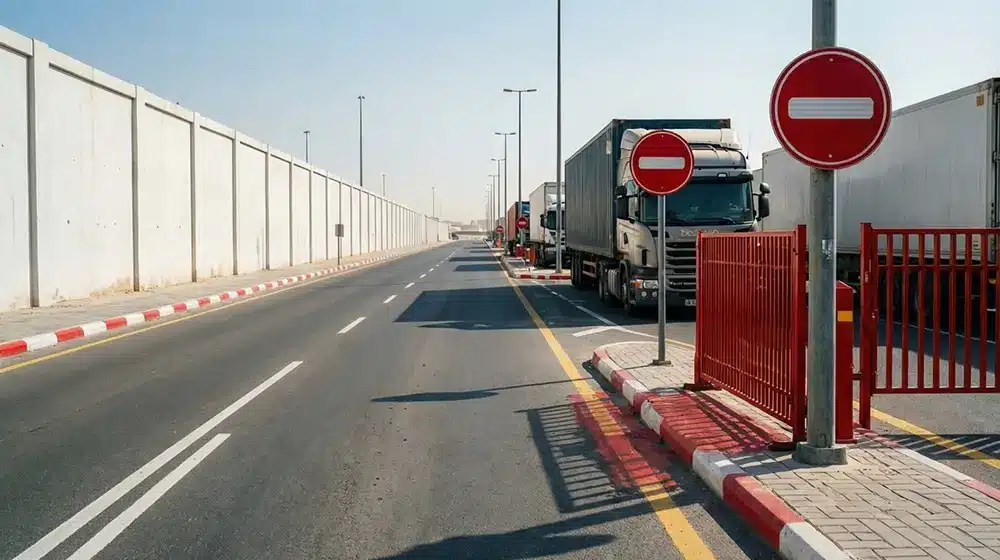

It prevents peak-hour fines, failed gate entry, and multi-truck congestion by mapping time restrictions, permit checkpoints, and a sequenced arrival plan that matches high-traffic windows and community access controls. Peak-hour restrictions in the wider Abu Dhabi Emirate include defined windows for heavy vehicles, including timing explicitly referenced for Al Ain in local reporting.
What counts as a “heavy vehicle” in timing restrictions?
A “heavy vehicle” is defined in local restriction notices by weight threshold and vehicle type. Abu Dhabi Police references restrictions for trucks at 2.5 tonnes and above in its published guidance on heavy truck bans during rush hours.
Local enforcement and restriction notices also reference freight trucks, tankers, and construction equipment when describing restricted-movement programs in the emirate.
What are the 2026 no-entry timing windows for heavy vehicles in Al Ain?

Al Ain timing windows commonly cited for heavy vehicle restrictions are:
- Morning: 6:30 am to 8:30 am
- Afternoon: 2:00 pm to 4:00 pm
These windows are reported as Al Ain-specific timing in UAE transport coverage about peak-hour restrictions.
Al Ain no-entry timing table
| City / Area | Restriction window 1 | Restriction window 2 | Notes |
|---|---|---|---|
| Al Ain | 6:30–8:30 | 14:00–16:00 | Peak-hour restriction windows cited in local coverage. |
Operational reading: these windows are the two periods where multi-truck arrivals and gate approvals fail most often, because community traffic peaks at the same time.
Why do these restrictions matter more in Al Ain villa and compound moves?
They compress the usable workday into fewer “clean” logistics blocks.
What changes on the ground during restricted windows?
- Gate entry queues increase, because residential traffic and school runs overlap.
- Security teams enforce plate and permit rules harder, because congestion creates complaints.
- Trucks cluster, because crews try to “make up time” and dispatch everything together.
That is when operators rack up:
- missed access windows
- repeat trips
- paid waiting time
- penalty exposure
What is the fastest way to plan loading and unloading around Al Ain no-entry timings?

Use a three-block day plan and treat restricted windows as hard stops, not flexible estimates.
The three-block day plan
- Block A (pre-6:30): staging, final packing, elevator protection, corridor protection, internal loading prep
- Block B (8:30–14:00): primary truck arrivals, loading, and first delivery wave
- Block C (16:00 onward): second delivery wave, re-assembly, carton placement, final handover
This structure prevents “all trucks at once” behavior that causes gate congestion and ticket risk.
What is multi-truck sequencing, and why does it reduce time loss in gated communities?
Multi-truck sequencing is a dispatch method where trucks enter a community in planned intervals, each with a defined cargo role, rather than arriving as a convoy.
A UAE mover coordination case note reports that 20 to 30 minute spacing can save 35% to 40% time by reducing queueing, blocking, and re-handling.
Practical meaning of the 20–30 minute spacing claim
Spacing:
- keeps the loading bay clear
- reduces security friction
- avoids fines triggered by congestion and road obstruction
- prevents fragile cargo from being parked in heat while waiting
What roles work best for Truck 1, Truck 2, Truck 3 in villa moves?

Define truck roles by handling sensitivity and unload priority.
Recommended truck role model
- Truck 1: Appliances and heavy base loads
Examples: fridge, washer, dryer, cooking range, heavy shelving
Goal: get the heavy footprint out first and clear rooms fast. - Truck 2: Fragile and high-value items
Examples: TV, monitors, artwork, mirrors, glass tops, decor crates
Goal: avoid heat soak and reduce idle time inside gated queues. - Truck 3: Garden and outdoor assets
Examples: planters, outdoor furniture, pergola parts, tools, bikes
Goal: avoid mixing outdoor dust and friction with indoor fragile loads.
Sequenced arrival model that fits the Al Ain timing windows
| Dispatch order | Role | Gate entry target | Spacing |
|---|---|---|---|
| Truck 1 | Appliances, heavy | 08:35–09:00 | Base truck |
| Truck 2 | Fragile | 09:05–09:30 | +20 to 30 min |
| Truck 3 | Garden | 09:30–10:15 | +20 to 30 min |
The spacing logic matches the reported time-savings framing (20–30 minutes, 35–40% time reduction) and reduces bay blockage.
Which rules inside gated communities cause the most “truck rejected at gate” failures?
Gate rejections concentrate in predictable categories:
Common gate failure triggers
- Plate not pre-registered
- Driver ID or crew list missing
- Wrong entry time window
- Truck arrives as a convoy and blocks lanes
- Permit mismatch for vehicle class
Control action: treat gate clearance as a “permit pack” event, not a verbal confirmation.
What permit and compliance checks apply for heavy vehicle movement?
Permitting differs by emirate system, road class, and vehicle type, but Abu Dhabi-side workflows commonly reference e-services and structured permit steps.
Permit pathways to know (Abu Dhabi ecosystem)
- UAE Ministry of Interior has a “heavy vehicle pass permit” service page describing required documents such as Emirates ID, commercial license, request letter, and vehicle registration cards.
- TAMM lists transport and driving services and includes permit-related workflows in its ecosystem.
Minimum “gate-ready” evidence pack for truck entry
- Vehicle registration copy
- Driver Emirates ID or ID details
- Crew list (names, count)
- Community access approval (email or portal screenshot)
- Route plan with arrival slots
- Cargo role sheet per truck (Truck 1 appliances, Truck 2 fragile, Truck 3 garden)
This is not paperwork for its own sake. It reduces repeat trips, which is the hidden cost driver during peak-hour restrictions.
How do peak-hour restriction updates affect planning across the emirate?
Abu Dhabi has published updates to restricted movement hours for heavy vehicles on Abu Dhabi roads, showing that restriction programs can change by road network and policy updates.
Operational takeaway for Al Ain operators: keep a “restriction check” step in dispatch, because timing windows and restricted corridors can change during policy updates or major events.
What is the best loading and unloading strategy to avoid congestion, fines, and heat damage?

Use a staging-first, sequencing-second, unload-zoning-third approach.
1) Staging-first controls
- Stage appliances near exit points first
- Stage fragile crates in a shaded indoor hold area
- Stage garden items outside, covered, and tagged by zone
2) Sequencing-second controls
- Release Truck 1 only after gate confirms slot
- Release Truck 2 after Truck 1 clears the bay
- Release Truck 3 after fragile is inside destination or delivered
3) Unload-zoning controls at destination
- Zone A: appliances and utility
- Zone B: fragile and electronics
- Zone C: garden and outdoor
This reduces cross-traffic between crews and prevents corridor gridlock.
What fines and enforcement risks are most linked to “all trucks at once” arrivals?
The enforcement risks come from:
- entering during restricted windows
- obstructing roads and gates
- failing permit conditions
Local reporting on peak-hour restrictions describes enforcement for violations as part of the restriction program context.
Because penalty structures can change, the safest compliance move is to treat timing and permit checks as pre-dispatch gates, not on-road decisions.
What internal SOP fits this topic and improves reliability?
Multi-Truck Sequencing SOP (Al Ain)
- T-48 hours: confirm community access rules and plate registration method
- T-24 hours: finalize truck role sheet + arrival slots
- T-12 hours: build permit pack per truck (driver, plate, crew list)
- Move day 06:00–08:20: staging, protection, and Truck 1 pre-load
- 08:30 restriction clears: Truck 1 enters and loads
- +20 to 30 minutes: Truck 2 enters with fragile
- +20 to 30 minutes: Truck 3 enters with garden
- 13:30 cutoff: position trucks outside before 14:00 restriction window
- 16:00 onward: second wave delivery and re-assembly
The 20–30 minute spacing aligns with the documented time-saving claim in multi-truck coordination guidance.
Frequently Asked Questions
What are Al Ain heavy vehicle no-entry timings?
Commonly cited peak-hour windows are 6:30–8:30 and 14:00–16:00.
What is the simplest way to avoid gated community congestion?
Use sequenced entry and avoid convoy arrivals during peak community traffic periods.
What spacing works best between trucks?
A mover coordination reference reports 20–30 minute spacing and links it to 35–40% time savings.
How do truck roles reduce delays?
Roles prevent re-handling: Truck 1 appliances, Truck 2 fragile, Truck 3 garden.
Which permits matter most before dispatch?
Heavy vehicle movement often requires permit checks and documents, and the UAE Ministry of Interior permit guidance lists typical requirements like Emirates ID and commercial license.
Do restricted movement hours change?
Yes. Abu Dhabi has published updates to restricted movement hours for heavy vehicles on Abu Dhabi roads, so checks before dispatch matter.