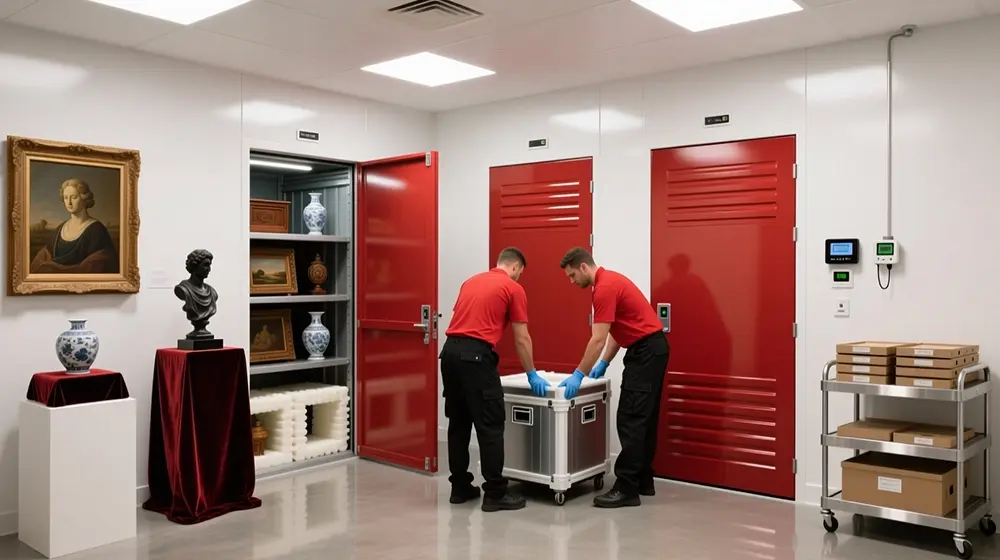
Art and antique storage requirements for Emirates Hills collectors sit at the intersection of conservation science and Dubai climate realities. Emirates Hills is one of Dubai’s most exclusive gated villa communities, with roughly six hundred large villas occupied by high net worth residents who often hold significant private collections. Many homes overlook golf courses and lakes, and their substantial wall areas, double height rooms, and basement levels can look ideal for art and antique storage at first glance.
Dubai’s external climate creates a different picture. The hot season runs for roughly four and a half months, from mid May to late September, with average daily highs above 38 degrees Celsius and August highs near 41 degrees. Relative humidity in the emirate often sits between about 42 percent and more than 60 percent, with winter months such as December reaching around 60 to 67 percent. Warm, moisture rich air accelerates corrosion, mould growth, and chemical reactions in wood, canvas, metal, and paper.
Leading museums respond to similar risks by targeting stable temperatures around 15 to 21 degrees Celsius and relative humidity around 40 to 60 percent, with particular materials kept near 45 to 55 percent. Preventive conservation standards also highlight that repeated fluctuations in temperature and humidity often create more damage than slightly flexible but stable conditions.
This blog links those evidence based benchmarks to practical art and antique storage requirements for Emirates Hills collectors. The focus stays on climate ranges, light levels, room selection, packing, monitoring, and documentation that mirror museum practice while fitting the architecture and everyday use of Dubai villas and specialised storage facilities.
Why do Emirates Hills collectors require museum level storage conditions in Dubai?
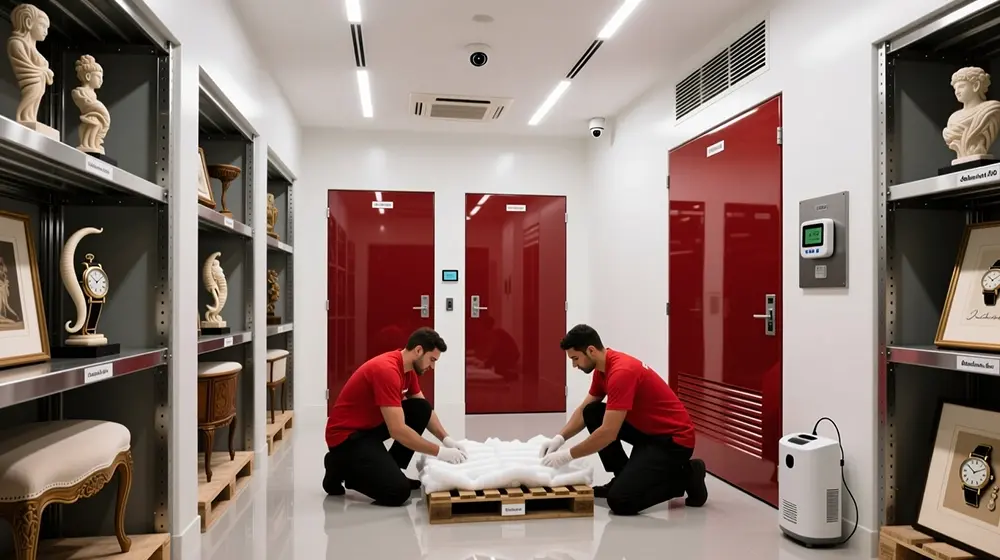
Art and antique storage requirements for Emirates Hills collectors follow museum level benchmarks because high temperatures, elevated humidity, and strong light in Dubai accelerate deterioration in valuable objects.
Emirates Hills villas sit within a city that records August average highs near 41 degrees Celsius and summer night temperatures close to 30 degrees. Even with effective air conditioning, walls, windows, and roofs still experience strong heat load for many hours each day. In parallel, outdoor relative humidity often reaches values above 60 percent in winter months and remains above 40 percent in many warmer months.
Paintings, works on paper, antique furniture, and mixed media objects react to that environment through mechanical and chemical change. Conservation guidance links unstable heat and moisture conditions to cracking, warping, lifting of paint layers, adhesive failure, corrosion, and mould risk. When collections in Emirates Hills carry six or seven figure values, these risks shift from theoretical concerns to direct material and financial exposure.
As a result, art and antique storage requirements for Emirates Hills collectors mirror museum standards that define target bands for temperature, relative humidity, and light, and that prioritise stability over rigid targets that fluctuate.
What climate benchmarks do leading museums use for temperature and humidity?
Leading museums often keep storage and display spaces for general collections near 15 to 21 degrees Celsius and relative humidity around 40 to 60 percent, with tighter ranges for fragile materials.
Guidance from major museum and heritage conservation bodies commonly points to similar targets. For many mixed collections, recommended temperatures sit between 15 and 20 degrees Celsius, with some institutions accepting limited variation up to 25 degrees Celsius when changes remain slow and controlled. Relative humidity benchmarks often cluster around 40 to 60 percent, with a preference for mid range values near 50 percent.
Many materials receive more specific ranges. Museum manuals often group oil paintings on canvas, ivory, horn, and wood as materials with critical relative humidity near 45 to 55 percent, because they expand and contract significantly as moisture levels change. Archival paper is often kept in similar or slightly narrower humidity ranges to reduce mould risk and slow acid driven degradation.
Benchmark temperature and humidity ranges used by many museums
Reference benchmarks used in museum style storage
| Collection type or context | Reference temperature range | Reference relative humidity range | Source context |
|---|---|---|---|
| General mixed collections | Around 15 to 21 degrees Celsius | Around 40 to 60 percent | Museum environment guidance and conservation reference summaries |
| Paintings, wood, ivory, horn, similar objects | Around 15 to 21 degrees Celsius | Often 45 to 55 percent | Material specific ranges commonly listed in museum manuals |
| Non sensitive materials | Around 15 to 25 degrees Celsius | Around 30 to 60 percent | Non sensitive categories used in environmental condition tables |
Dubai’s climate places more stress on storage than many temperate locations, so art and antique storage requirements for Emirates Hills collectors emphasise strong separation between outdoor conditions and controlled indoor conditions.
Climate summaries indicate that Dubai experiences a hot season of more than four months with average highs above 38 degrees Celsius, and the coldest month still has average highs near 24 degrees. Relative humidity varies across the year from around 42 percent in drier months to around 60 percent or more in cooler months.
These ranges overlap with museum relative humidity bands but reach far higher temperatures, particularly outdoors and in unconditioned spaces. Warm air at elevated humidity supports mould growth on organic surfaces and increases corrosion risk for metals. The same combination can also contribute to salt crystallisation cycles on some stone and ceramic surfaces.
For Emirates Hills villas, this climate context means garages, roof spaces, service corridors, and partially cooled rooms often drift far outside museum style benchmarks. Art and antique storage requirements for Emirates Hills collectors therefore favour interior rooms with predictable cooling, limited exposure to external walls, minimal proximity to water pipes, and controlled air movement.
Which storage requirements apply inside Emirates Hills villas?
Inside Emirates Hills villas, art and antique storage requirements centre on choosing stable rooms, managing air conditioning zones, and controlling moisture entry points.
Room selection principles used in museum style stores
- Prefer interior rooms with no external windows, or with limited exposure, because external walls and glazing experience faster temperature swings.
- Avoid wet adjacencies such as kitchens, bathrooms, laundry areas, and pool plant rooms, since plumbing and steam create local humidity peaks and raise leak risk.
- Reduce pipe and drain proximity by selecting spaces with minimal overhead or concealed water lines where possible.
- Limit direct sunlight and strong artificial light, especially for works on paper, textiles, and dyed surfaces.
HVAC and moisture control inside the chosen zone
- Temperature set points: Keep temperatures close to 18 to 20 degrees Celsius with slow seasonal adjustment rather than frequent daily changes.
- Relative humidity trimming: Use dehumidification or humidification to keep values near 45 to 55 percent, aiming for stability.
- Continuous monitoring: Use data logging to track trends and identify daily or weekly fluctuations, short cycling, or door opening effects.
Interior layout and storage furniture choices
- Elevate storage with shelving and racks to keep objects away from floors in case of minor water events.
- Use enclosed furniture such as cabinets and plan chests for works on paper to reduce dust and handling.
- Install freestanding framed art racks to create narrow aisles, lower movement risk, and reduce contact damage during retrieval.
What evidence based light and UV limits matter for Emirates Hills collections?
For Emirates Hills collections, art and antique storage requirements follow museum practice that keeps storage areas at very low light levels and display areas within strict lux limits.
Light management benchmarks used in museum practice
- Storage areas
- Kept at very low light levels, with lights used only when staff are present.
- Priority is to minimise cumulative exposure over time, not only peak brightness.
- Highly light sensitive collections
- Works on paper, photographs, and textiles are typically treated as highly sensitive.
- Exhibition lighting is commonly limited to around 50 lux, with storage kept much darker.
- Many museum manuals also limit display duration to short exhibition windows followed by multi year rest periods to manage lifetime exposure.
- Moderately sensitive or less sensitive objects
- Many paintings and some decorative objects may tolerate up to about 200 lux on display.
- The same logic applies: controlled duration and stable conditions matter as much as the lux level.
Light level benchmarks relevant to Emirates Hills collectors
| Material sensitivity class | Storage light level | Typical museum display range | Source context |
|---|---|---|---|
| Highly sensitive works on paper, photographs, textiles | Near dark in storage, brief checks only | Often up to fifty lux in display with limited exhibition time | Conservation guidance for sensitive collections |
| Moderately sensitive paintings and objects | Very low light in storage | Often up to one hundred to two hundred lux | Museum lighting bulletins and manuals |
Dubai interiors often feature bright decorative lighting and large glazed areas, especially in Emirates Hills villas.As a result, art and antique storage requirements for Emirates Hills collectors favour dedicated storage rooms with no direct daylight, light tight cabinets, closed doors and artificial light that remains off except during access.
How can Emirates Hills collectors apply museum benchmarks to paintings and works on paper?
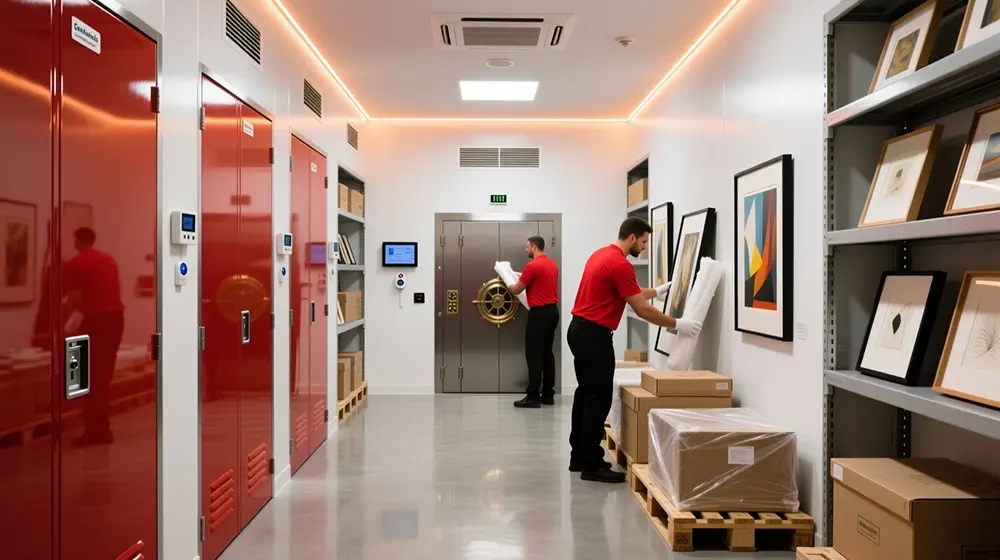
For paintings and works on paper, art and antique storage requirements for Emirates Hills collectors draw directly from museum approaches to climate, enclosure and handling.
Key evidence based elements include the following.
- Climate band
- Temperature near eighteen to twenty degrees Celsius.
- Relative humidity near forty five to fifty five percent, with minimal daily swings.
- Framing and glazing
- Robust frames with sealed backs and spacers prevent contact between works and glazing.
- Glazing with ultraviolet filtering reduces light damage from any stray illumination.
- Storage position
- Vertical storage racks for framed works limit pressure on surfaces.
- Plan chests or solander boxes for unframed works on paper protect against dust, light and impact.
- Handling routes
- Pre-planned paths from storage rooms to viewing spaces avoid tight corners, steep stairs and direct sunlight.
- Protective blankets and corner protectors reduce impact risk during short movements.
These measures support art and antique storage requirements for Emirates Hills collectors who wish to keep paintings and works on paper within museum style safety margins despite Dubai climate pressures.
How can Emirates Hills collectors apply museum benchmarks to furniture, sculpture, and mixed media objects?
Furniture, sculpture, and mixed media objects in Emirates Hills collections can show complex responses to climate. Art and antique storage requirements therefore emphasise physical support, floor clearance, and material compatibility.
Museum environment tables often group wood, bamboo, cane, lacquer, ivory, horn, and composite frame mouldings as humidity sensitive, commonly performing best near 45 to 55 percent relative humidity. Mixed media works that combine wood, metal, coatings, and adhesives can respond even more strongly to fluctuations.
Practical storage principles for Emirates Hills collections
1. Stable shelving and pallets
- Place heavy furniture and sculpture on fixed shelving or pallets, with low vibration and stable load bearing.
- Keep clear of floors to reduce risk from minor water events and to support air circulation.
2. Breathable covers
- Use inert, breathable dust covers rather than plastic films that can trap moisture.
- Keep covers loose and non contacting around fragile or friable surfaces.
3. Supports and cushioning
- Use custom blocks, foams, and mounts to distribute weight evenly across legs, bases, and projections.
- Avoid direct contact from raw wood or acidic cardboard against sensitive surfaces.
4. Zoned storage
- Store materials with similar climate tolerance together, so one stable range protects a group.
- Separate higher risk composites or unstable mixed media into the most stable zone.
These approaches keep art and antique storage requirements for Emirates Hills collectors aligned with preventive conservation while fitting villa basements, safe rooms, and specialised external storage facilities.
What monitoring and documentation practices align Emirates Hills storage with museum standards?
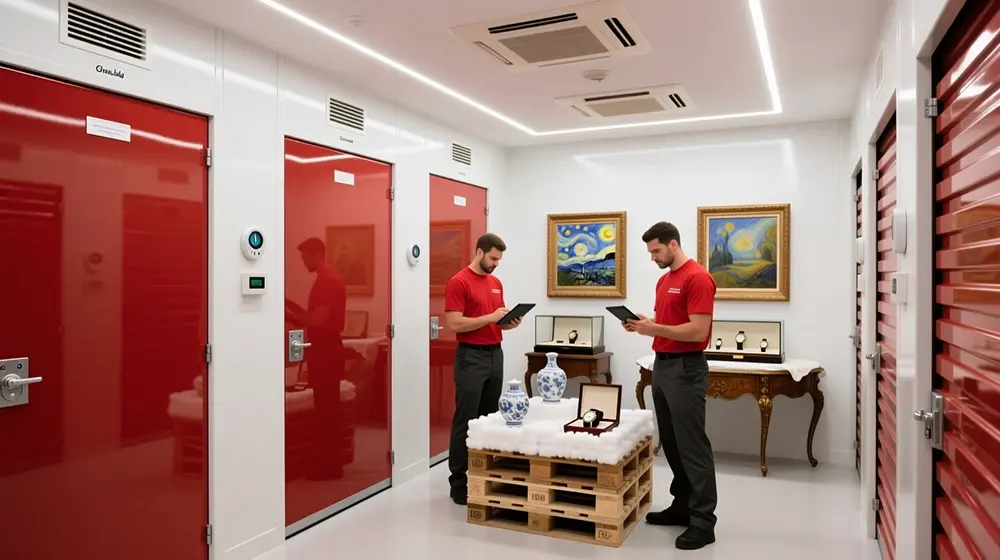
Monitoring and documentation are central to art and antique storage requirements for Emirates Hills collectors who want to follow museum practice.
Museums treat temperature, relative humidity, light, and airborne risks as measurable targets. Digital data loggers record conditions at short intervals in storage and display spaces, then patterns are reviewed for daily and seasonal fluctuations. Light meters confirm that storage stays dark and display stays within agreed lux limits.
Practical monitoring steps for collectors
- Install data loggers in each dedicated storage space and in key display rooms.
- Download and review graphs periodically to identify peaks, dips, and rapid swings.
- Check light levels during typical room use, not only during quiet hours.
- Create condition reports with dated photographs for each major object or group.
- Maintain a simple movement and incident log covering relocations, loans, inspections, and any events.
These records support insurers, valuers, and conservators, and they demonstrate alignment with evidence based benchmarks rather than informal estimates.
Quick self check for Emirates Hills storage plans
Use this checklist to test current storage against museum style benchmarks.
- Is at least one room maintained near 18 to 20 degrees Celsius with measured stability?
- Does relative humidity remain near mid range values, ideally around 45 to 55 percent, with minimal daily fluctuation?
- Do storage areas remain dark except during access?
- Are the most sensitive works stored in enclosures rather than left open on walls?
- Do environmental graphs and condition photos exist for key works?
Mostly positive answers suggest strong alignment. Mixed answers highlight clear priorities for improvement.
Conclusion: Turning museum benchmarks into a long term storage strategy
Art and antique storage requirements for Emirates Hills collectors reach beyond decoration and comfort. They echo preventive conservation strategies designed to protect collections across generations.
Dubai introduces sustained heat, variable humidity, and intense light. Even so, Emirates Hills villas and climate controlled facilities can support controlled microclimates when room choice, enclosure design, and monitoring are handled systematically. Museum practice consistently emphasises temperature control near 15 to 21 degrees Celsius, relative humidity near 40 to 60 percent (often best near 45 to 55 percent for many sensitive materials), low light, restricted exposure for fragile works, and a strong focus on stability over frequent adjustment.
When collectors adopt these benchmarks, select appropriate rooms, invest in mounts and enclosures, and track conditions with data logging plus condition reporting, private storage starts to resemble museum storage rather than a spare room solution. That reduces restoration risk, supports insurance discussions, and preserves financial and emotional value.
Frequently Asked Questions
What temperature target fits art and antique storage requirements for Emirates Hills collectors?
What relative humidity range supports most Emirates Hills collections?
Why do fluctuations matter more than exact numbers for Emirates Hills storage?
How bright can lighting be in an Emirates Hills storage room for sensitive works?
What places inside Emirates Hills villas create higher risk for art and antique storage?
How relevant are external climate controlled facilities to Emirates Hills collectors?
Which materials react fastest to poor storage in Dubai conditions?
What simple monitoring tools support museum style storage in Emirates Hills villas?
How do storage requirements interact with insurance?
What first steps bring Emirates Hills storage closer to museum benchmarks?
Hayyan is a logistics veteran with over 15 years of experience in facility management and spatial optimization. He specializes in warehouse security, climate-controlled storage protocols, and the technical logistics of large-scale moving. His focus is on helping clients maximize their square footage while ensuring the long-term preservation of their inventory and belongings.
Thuraya is a specialist in home organization and residential transition management. With a background in interior space planning, she helps individuals navigate the complexities of downsizing and relocation. She provides expert advice on packing fragile items, choosing optimal storage unit sizes, and turning the stress of moving into a seamless, organized experience.