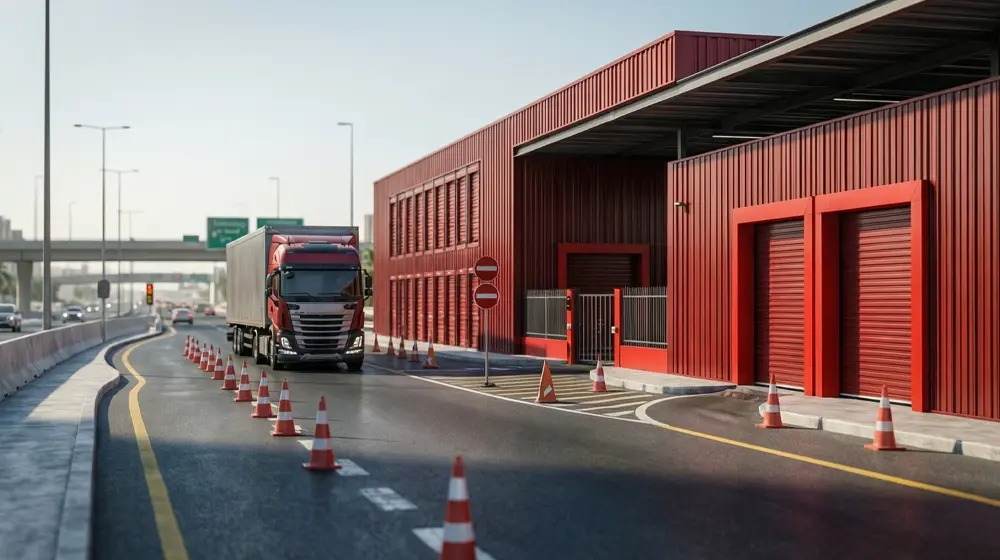
Sharjah self storage access depends on vehicle class, permitted routing, and peak hour truck bans because E311 (Sheikh Mohammed bin Zayed Road) and E611 (Emirates Road) carry a large share of truck based move in and move out traffic into Sharjah. Published corridor controls include an E611 evening peak truck ban toward Sharjah (5:30 PM to 8:00 PM) effective 1 January 2025 and E311 peak period truck restrictions on the Ras Al Khor to Sharjah section.
What does “No Entry” mean for a self storage move in Sharjah?
“No Entry” means a prohibited movement defined by traffic signage and enforced by monitoring and penalties, so the move route converts into a compliant detour or a delayed arrival. In self storage operations, “No Entry” appears in these forms:
- Vehicle class exclusion (heavy vehicle or lorry restriction)
- Time window restriction (peak hour truck ban)
- Mandatory route rule (truck corridor enforcement with penalties for non compliance)
Sharjah also enforces lane and route discipline for heavy vehicles using smart monitoring, which increases the cost of route mistakes near industrial corridors.
Which E611 rule changes Sharjah self storage access the most?
E611 restricts truck movement toward Sharjah from 5:30 PM to 8:00 PM starting 1 January 2025 on the section between Al Awir Street and Sharjah. Dubai RTA and Dubai Police published the restriction and effective date.
What changes in storage access during the E611 evening truck ban?
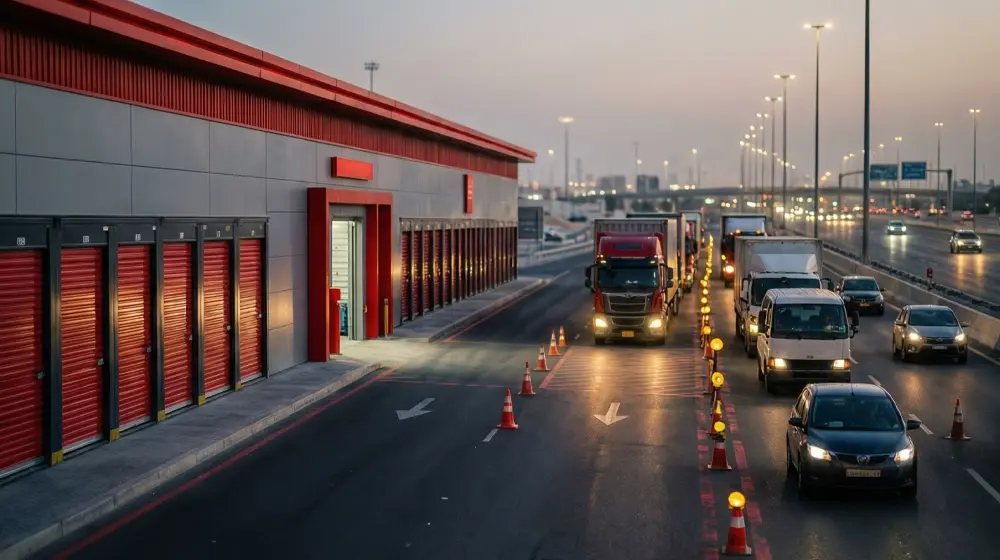
Truck based arrivals into Sharjah lose the 150 minute evening peak window, so delivery scheduling compresses into pre ban and post ban slots. Common access outcomes:
- Move in slot loss when a truck reaches the corridor after 5:30 PM
- Staging delays when vehicles wait near corridor transitions until 8:00 PM
- Higher missed appointment probability when unloading time exceeds the remaining compliant window
Dubai RTA frames the restriction as congestion and safety control on an arterial segment, so the constraint remains predictable rather than ad hoc.
Which E311 rule changes Sharjah self storage access the most?
E311 restricts truck movement between Ras Al Khor Road and Sharjah in both directions during three daily peak windows: 6:30 AM to 8:30 AM, 1:00 PM to 3:00 PM, and 5:30 PM to 8:00 PM under the adjusted schedule announced in 2024. Dubai RTA published the schedule, and DubaiTrade summarized the restricted area and times.
What changes in storage access during the E311 truck restriction windows?
Cross emirate transfers into Sharjah lose flexibility because a single route segment carries multiple daily restriction blocks. Typical effects:
- Arrival time variance increases for Dubai to Sharjah storage transfers
- Driver duty compression increases when dispatch misses the pre window cut off
- Quote variance increases when logistics providers add buffer minutes for detours and waiting
Which customer trips into Sharjah self storage face the highest disruption?
Trips that use a commercial vehicle or a truck face the highest disruption because published restrictions target truck movement. Storage trips segment into three operational groups:
1. Private car drop offs
- Lower compliance risk from truck bans
- Higher congestion sensitivity during peaks
2. Pickup and van moves
- Mixed exposure depending on classification and route control
- Higher wrong turn exposure near industrial zones
3. Box truck and heavy truck moves
- Direct exposure to E611 and E311 restriction windows
- Highest penalty exposure under mandatory route enforcement
How does Sharjah lane and route enforcement increase storage access risk?
Sharjah lane and route enforcement increases storage access risk by converting route mistakes into fines and traffic points for heavy vehicles, which reduces subcontractor reliability. Published reporting on Sharjah enforcement cites:
- AED 1,500 and 12 traffic points for heavy vehicles that do not comply with mandatory route requirements
- AED 500 for non compliance with traffic signs and instructions
- Enforcement via radars and smart camera systems on key streets
This enforcement pattern matters for self storage because the last mile into storage corridors often includes lane discipline, turn restrictions, and sign dense access roads.
How does Sharjah Civil Defence affect self storage move in operations?
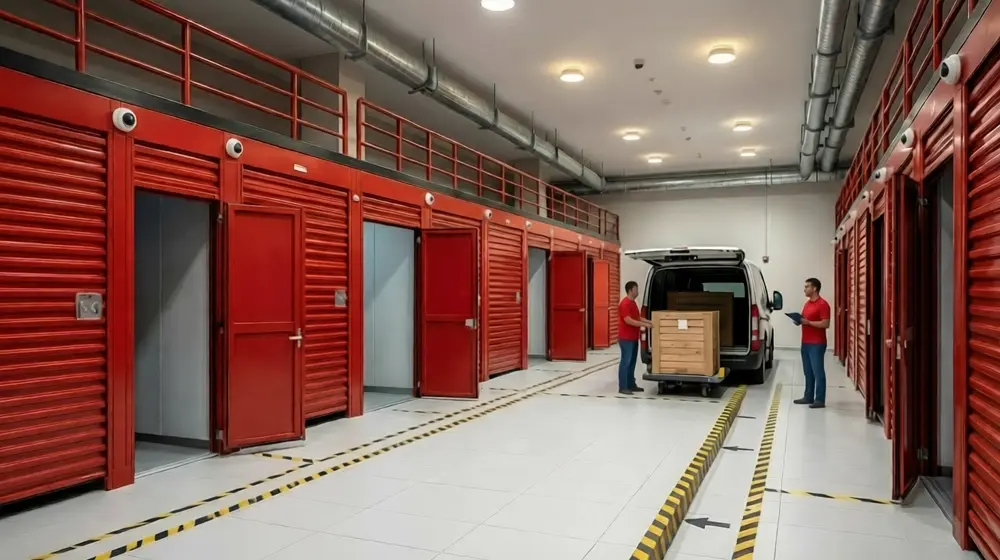
Sharjah Civil Defence affects self storage move in operations by enforcing measurable storage safety limits that control stacking height, sprinkler clearance, and rack spacing. Gulf News reports campaign guidance for facilities without automatic fire suppression systems:
- Storage height not exceeding 3 metres
- 1 metre clearance below sprinkler systems
- Racks spaced 1 metre from walls and other structures
- Mezzanine floors limited to 50 percent of ground floor area
WAM also reports the same operational clearance and height controls in Sharjah industrial regions.
What changes for a storage customer during move in?
Unload sequencing becomes stricter because temporary stacking that blocks aisles or reduces clearance creates compliance risk. Measurable move in effects:
- More handling steps when cartons require staged placement rather than corridor stacking
- Longer unload time when bulky items require position planning to maintain clearance
- Higher labour minutes on high volume moves
How does E Self Storage fit this Sharjah access reality without changing the informational intent?
E Self Storage fits Sharjah access constraints by offering self storage usage modes that reduce truck dependent peak hour exposure, including features such as 24 by 7 access and operational pickup options described on its site. This alignment matters because access planning becomes a time window and vehicle type problem under E311 and E611 restrictions.
(Informational note: the operational logic applies to any Sharjah self storage operator that supports flexible access windows and coordinated pickups.)
What routing and scheduling rules reduce missed access for Sharjah self storage?

Missed access reduces when dispatch avoids published restriction windows and when unloading preserves Civil Defence clearance constraints. Apply these controls as factual scheduling rules:
Dispatch timing controls
- Schedule Sharjah inbound truck legs outside E611 5:30 PM to 8:00 PM, because the corridor restriction applies toward Sharjah from 1 January 2025.
- Avoid E311 truck restriction windows on the Ras Al Khor to Sharjah segment: 6:30–8:30, 1:00–3:00, 5:30–8:00.
Route compliance controls
- Use a route plan that respects designated heavy vehicle corridors because Sharjah enforcement uses smart monitoring and penalties for non compliance.
Unloading and staging controls
- Keep stacking height and clearances within campaign guidance because non compliant staging increases interruption risk.
Table: E311 and E611 restrictions mapped to Sharjah self storage failure modes
This table defines each published control, the failure mode it creates for storage access, and the control that reduces the failure probability.
| Published control | Corridor scope | Access failure mode in self storage | Control that reduces failure |
|---|---|---|---|
| E611 truck ban toward Sharjah 5:30 PM to 8:00 PM effective 1 Jan 2025 | Emirates Road between Al Awir Street and Sharjah | Truck arrival becomes non compliant inside the window, causing waiting or re routing | Dispatch pre 5:30 PM or post 8:00 PM for truck legs |
| E311 truck restrictions in three daily windows | Sheikh Mohammed bin Zayed Road between Ras Al Khor Road and Sharjah both directions | Appointment miss from peak window overlap and route compression | Build dispatch windows around 6:30–8:30, 1:00–3:00, 5:30–8:00 |
| Sharjah heavy vehicle mandatory route and sign compliance enforcement | Sharjah monitored road network | Fine and points exposure, detours after enforcement, re attempt deliveries | Route compliance SOP and driver briefing for corridor approach |
| Civil Defence storage stacking and clearance controls | Facility operations and industrial inspections | Longer unload time and re handling when staging blocks aisles or violates clearance | Sequence unload to maintain 3 m height and 1 m clearance rules |
Table outro: Sharjah self storage access reliability increases when a customer treats E311 and E611 as time restricted freight corridors and treats unloading as a clearance controlled staging process.
What booking logic matches Sharjah self storage constraints for common customer types?

Booking logic matches Sharjah constraints when the booking step classifies the move by vehicle type and by corridor time exposure. Use these operational categories:
Studio and small unit customers
- Private car drop off fits most peak restrictions
- Peak congestion still increases arrival variance
Apartment furniture move customers
- Pickup van and box truck trips require corridor window planning
- E611 evening inbound window becomes the main failure point for after work moves
Business inventory and archive storage customers
- Freight style moves require route compliance discipline
- E311 multiple daily windows increase scheduling complexity for inter emirate transfers
What is the practical conclusion for self storage in Sharjah?
Sharjah self storage access depends on compliance timing and compliant routing because E611 and E311 include published truck restriction windows and Sharjah enforcement penalises route and sign violations, while Civil Defence campaigns impose measurable staging constraints inside facilities. The operational solution is scheduling discipline, route discipline, and clearance compliant unloading.
Hayyan is a logistics veteran with over 15 years of experience in facility management and spatial optimization. He specializes in warehouse security, climate-controlled storage protocols, and the technical logistics of large-scale moving. His focus is on helping clients maximize their square footage while ensuring the long-term preservation of their inventory and belongings.
Thuraya is a specialist in home organization and residential transition management. With a background in interior space planning, she helps individuals navigate the complexities of downsizing and relocation. She provides expert advice on packing fragile items, choosing optimal storage unit sizes, and turning the stress of moving into a seamless, organized experience.