Climate controlled storage delivers a positive cost benefit for furniture in Sharjah when furniture includes wood veneer, solid timber, leather, fabric upholstery, or boxed textiles, because Sharjah records high relative humidity patterns that accelerate mould risk and material distortion. Sharjah humidity datasets show sustained high readings at weather stations, and indoor guidance from EPA and ASHRAE ties mould risk to relative humidity levels above ~60%.
What is the real decision between climate controlled and standard storage in Sharjah?
The decision is “humidity exposure risk versus monthly storage spend” for furniture, because humidity drives mould probability, wood moisture content, metal corrosion, and odour retention. Sharjah’s average relative humidity sits around the low 60% range by common climatology summaries, with month-to-month movement that still stays close to mould-risk thresholds.
What is “climate controlled storage” for furniture protection?
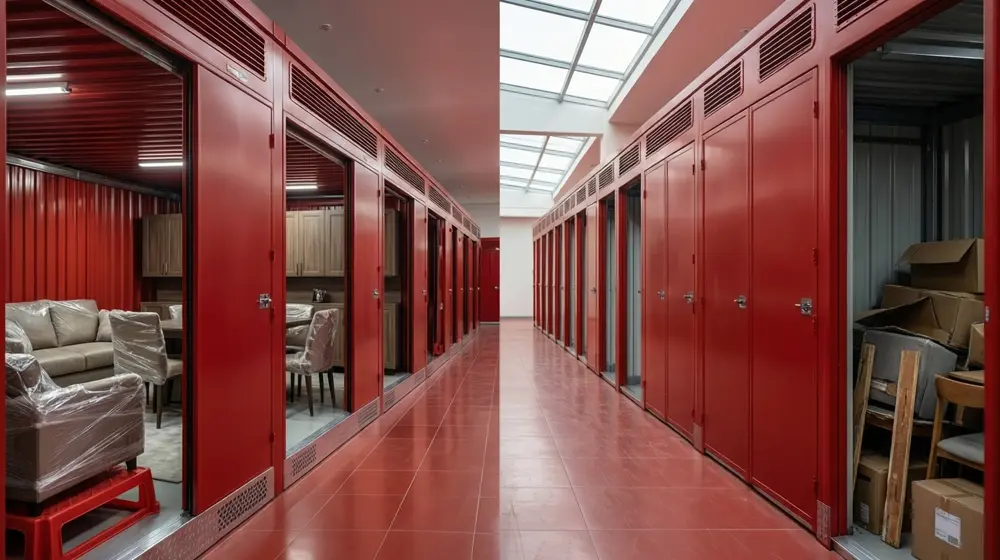
Climate controlled storage is a storage environment that controls temperature and reduces humidity volatility using continuous air conditioning and ventilation, which reduces furniture moisture uptake and mould growth conditions. UAE operators describe climate control as air-conditioned storage maintained at stable indoor ranges.
What is “standard storage” in Sharjah in practical terms?
Standard storage is non-AC or minimally conditioned storage where interior humidity tracks outdoor humidity more closely, so furniture protection depends more on packaging quality and airflow. In coastal UAE climates, standard storage exposes furniture to higher humidity swings, especially in long-term storage.
Why does Sharjah humidity change the furniture storage equation?
Sharjah humidity changes the equation because mould growth risk increases when relative humidity exceeds ~60%, and furniture materials absorb moisture when ambient RH stays elevated. EPA guidance references keeping indoor humidity below 60% (ideal 30–50%) to reduce mould risk, and ASHRAE references occupied-space humidity ranges such as 30–60% and guidance to control RH to reduce microbial-growth conditions.
Sharjah climate summaries report average monthly RH spanning roughly the low 50s to high 60s, with an annual average around ~61%.
UAE government climate indicators also show very high maximum relative humidity readings at some UAE stations, including Sharjah Airport station records on the dashboard.
Which furniture types gain the highest benefit from climate controlled storage in Sharjah?
Climate control benefits furniture with hygroscopic materials and layered finishes because these materials change dimension and support microbial growth under sustained humidity. Highest-benefit categories:
- Solid wood and veneer furniture (wardrobes, beds, dining tables)
- Upholstered sofas and mattresses (foam + fabric moisture retention)
- Leather furniture (surface cracking risk from poor conditioning, odour retention under dampness)
- Rugs, curtains, boxed textiles (mould and odour risk)
- Composite boards (swelling and delamination sensitivity in damp conditions)
Indoor humidity education sources explicitly connect high humidity with damage to furnishings and mould development above ~60% RH.
Which furniture types tolerate standard storage better in Sharjah?
Standard storage fits furniture that has low moisture sensitivity or that is stored short-term with sealed packaging and airflow controls. Lower-risk categories:
- Powder-coated metal frames without fabric
- Hard plastics and resin outdoor items
- Sealed, factory-packaged flat-pack items with intact wrap
- Items stored for short duration where retrieval is frequent
This category still depends on packaging quality and avoidance of trapped moisture.
How much does self storage cost in Sharjah, and where does climate control sit in the price range?
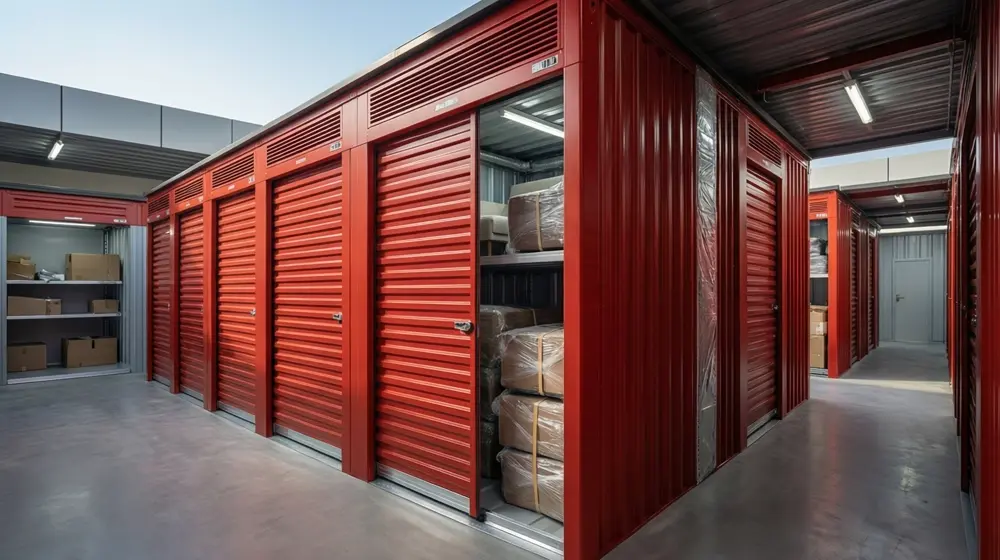
Sharjah self storage pricing clusters by unit size, term length, and amenities, and climate control sits as an amenity that operators price at a premium or bundle as a standard feature. Market pages and guides commonly cite ranges such as:
- Small units (about 1–5 sqm): AED 150–350 per month
- Medium units: AED 400–800 per month
- Large units: AED 850–1,500 per month, with climate-controlled large units reaching AED 1,500+ in some Sharjah pricing descriptions
Some operators state that units are fully air-conditioned as a default feature for Sharjah storage offerings, which shifts the decision from “AC add-on” to “AC included” for furniture protection positioning.
E Self Storage’s own price-index style content also states that users pay premiums for climate control and central locations, which matches the “amenity premium” pattern in the UAE market.
What is the cost-benefit logic for furniture, expressed as a decision model?
Climate controlled storage has a positive cost benefit when the expected damage cost exceeds the monthly premium or the replacement cost of furniture exceeds the total storage spend. Use this model:
Step 1: Classify furniture value and sensitivity
- Replacement value bracket: AED 2,000 / AED 10,000 / AED 25,000+
- Material sensitivity: wood veneer, solid wood, upholstery, leather = high sensitivity
Step 2: Define storage duration
- 0–4 weeks
- 1–6 months
- 6–24 months
Humidity exposure compounds with time because mould and odour issues depend on sustained dampness events.
Step 3: Estimate damage consequence
- Upholstery mould remediation and persistent odour often converts into replacement rather than cleaning, especially for foam-based items.
- Wood moisture movement can convert into joint loosening, veneer lift, and warping patterns.
Humidity guidance sources connect >60% RH conditions to mould probability and furnishings damage, which supports treating humidity control as a risk-reduction expense rather than a comfort expense.
Table: Climate controlled vs standard storage in Sharjah for furniture
This table defines the decision variables that change the cost-benefit outcome for furniture storage in Sharjah.
| Decision variable | Standard storage outcome | Climate controlled outcome | Cost-benefit signal |
|---|---|---|---|
| Sharjah humidity exposure | Higher RH volatility and higher damp-risk periods | Reduced RH volatility via continuous conditioning | Climate control gains value when storage duration increases |
| Upholstery and textiles | Higher mould and odour probability above ~60% RH | Lower mould probability when humidity stays controlled | Climate control gains value for sofas, mattresses, rugs |
| Wood and veneer | Moisture uptake increases distortion and finish stress | Moisture uptake reduces as RH stabilises | Climate control gains value for wardrobes, beds, cabinets |
| Monthly spend in Sharjah | Lower cost bands common in small units | Higher bands for large climate-controlled units appear in Sharjah ranges | Standard fits low-value or short-duration storage |
| Operator positioning | Mixed “AC optional” market | Some providers bundle AC as default in Sharjah units | “All units AC” removes the main tradeoff for furniture |
Table outro: The cost-benefit shifts toward climate control when furniture contains moisture-sensitive materials and storage duration exceeds one month in a high-humidity environment.
What packaging steps keep furniture safe even in climate controlled units?
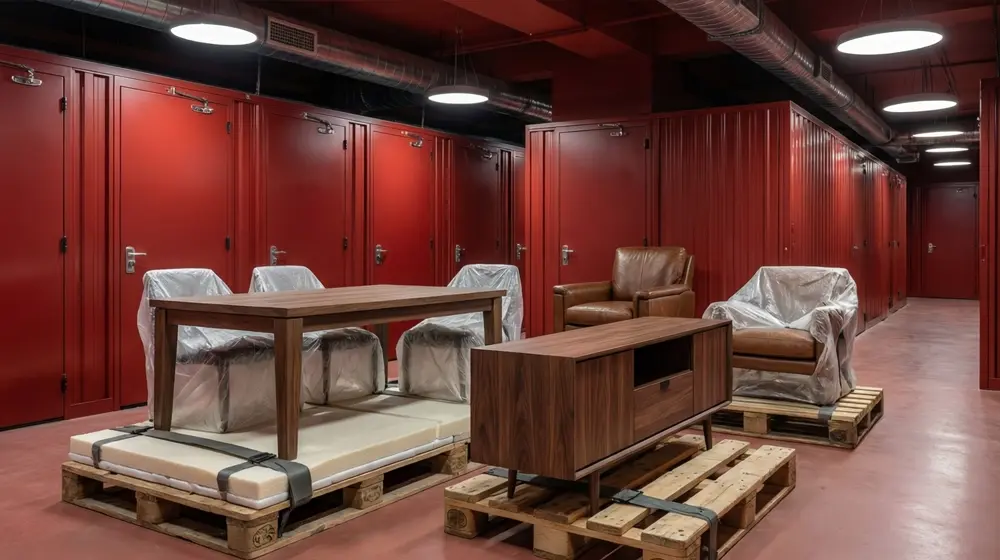
Packaging still matters because trapped moisture creates microclimates inside plastic wraps even when room air is conditioned. Effective controls:
- Dry-clean and fully dry fabrics before storage
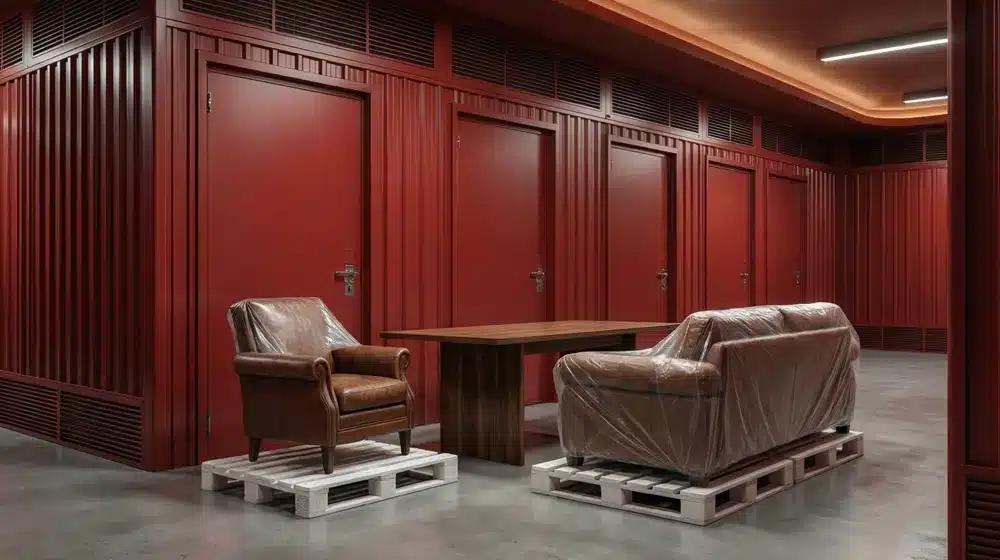
- Use breathable covers for upholstery instead of fully sealed plastic
- Elevate furniture off the floor with pallets to reduce condensation contact
- Separate wood from walls to keep airflow
- Store mattresses vertically only if manufacturer permits to avoid structural distortion
EPA mould guidance treats moisture control as the primary prevention mechanism, which supports “dry first, then store” as a non-negotiable control.
What is the commercial conclusion for furniture storage in Sharjah?
Climate controlled storage delivers the stronger cost-benefit for furniture in Sharjah because humidity sits near mould-risk thresholds for long periods, and furniture materials (wood, textiles, leather) convert humidity exposure into irreversible damage costs. Pricing ranges in Sharjah show storage costs that stay below many furniture replacement values, so the cost-benefit favours protection when furniture value is moderate-to-high and storage duration exceeds one month.
Hayyan is a logistics veteran with over 15 years of experience in facility management and spatial optimization. He specializes in warehouse security, climate-controlled storage protocols, and the technical logistics of large-scale moving. His focus is on helping clients maximize their square footage while ensuring the long-term preservation of their inventory and belongings.
Thuraya is a specialist in home organization and residential transition management. With a background in interior space planning, she helps individuals navigate the complexities of downsizing and relocation. She provides expert advice on packing fragile items, choosing optimal storage unit sizes, and turning the stress of moving into a seamless, organized experience.