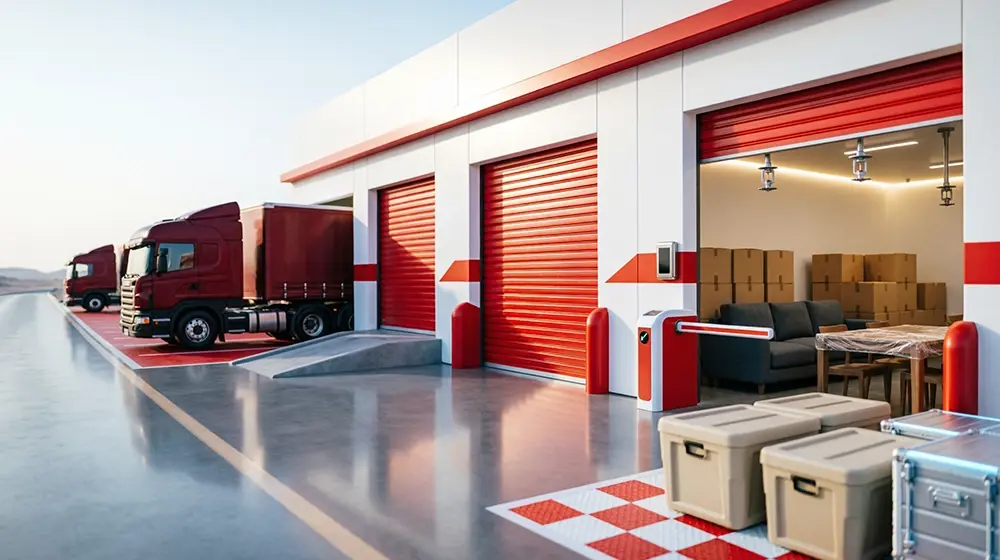
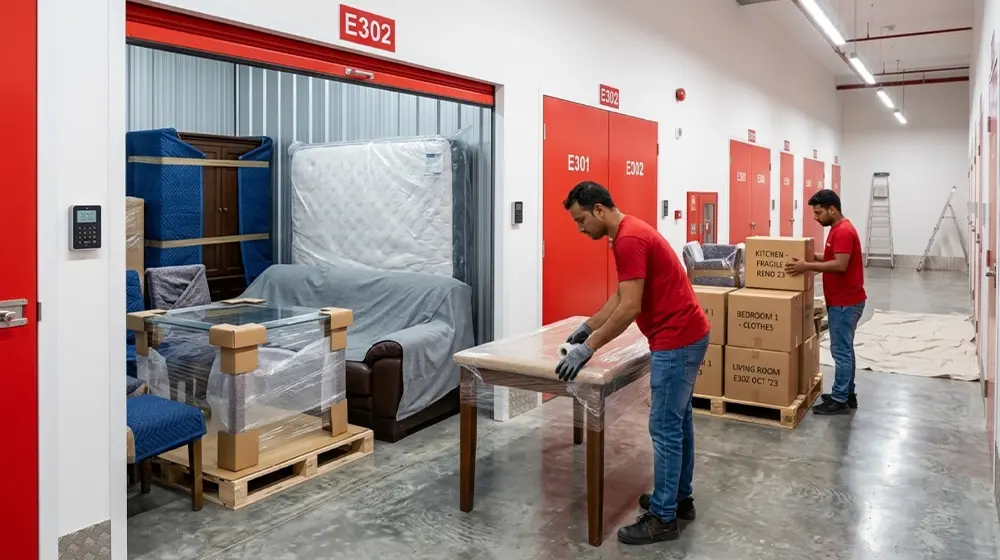
Furniture storage in Sharjah protects sofas, beds, wardrobes, dining sets, office desks, and upholstered items during moving, renovation, downsizing, and temporary travel. The safest storage setup combines a clean indoor unit, controlled access, stable humidity, and correct packing because humidity, moisture, and poor airflow increase mold risk and material damage in wood, leather, fabric, and paper-based items. EPA guidance keeps indoor humidity below 60%, ideally 30% to 50%, while CDC guidance says indoor humidity stays safest no higher than 50%.
What is furniture storage in Sharjah?
Furniture storage in Sharjah is a short-term or long-term storage service for household and business furniture. The service solves one practical problem: furniture still has value, but the current property does not have enough safe space. Self storage in Sharjah already covers residential, business, commercial, box, warehouse, and luggage use cases, which shows that the local storage model supports both home furniture and office furniture transitions.
Why do people use furniture storage in Sharjah?
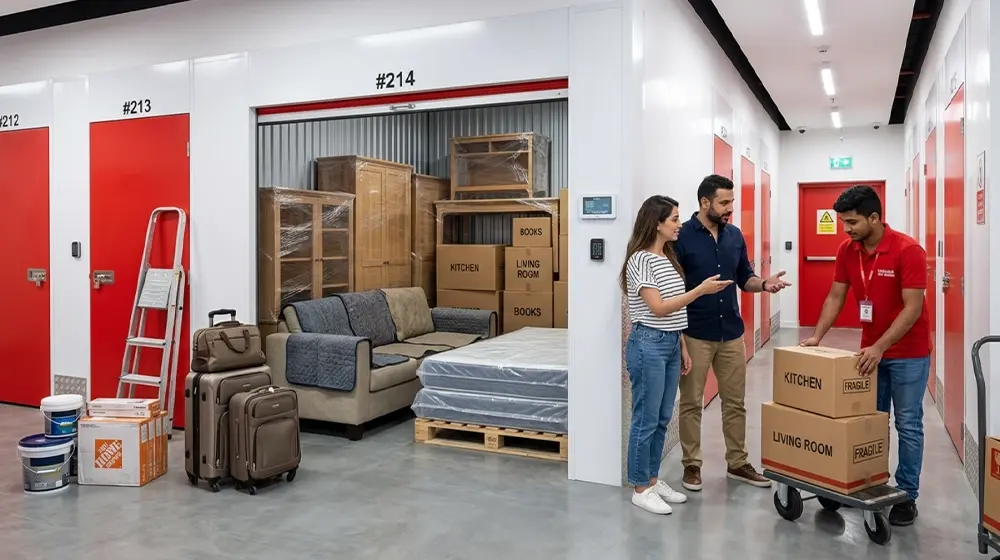
People use furniture storage in Sharjah for 5 main reasons: moving, renovation, downsizing, travel, and office reconfiguration. These 5 reasons share one storage condition: furniture remains useful, but available floor space becomes temporarily limited or operationally unsuitable. ESelf Storage’s Sharjah service page connects local storage demand with home shifting, decluttering, renovation, travel, and business storage use cases.
The 5 most common use cases are:
- Store furniture during move-out and move-in gaps
- Store furniture during villa or apartment renovation
- Store extra furniture after downsizing
- Store household furniture during overseas travel
- Store desks, chairs, and cabinets during office changes
Which furniture materials face the highest storage risk?
Wood, veneer, leather, fabric, foam, and cardboard-packed furnishings face the highest storage risk because moisture changes material condition over time. The U.S. Forest Service states that controlled moisture content avoids major dimensional-change problems in wood, while CPSC and EPA both connect damp conditions with mold, mildew, and biological growth risk. Climate controlled storage in Sharjah becomes more relevant when the furniture mix includes moisture-sensitive materials or long-duration storage.
The highest-risk furniture categories are:
- Wood furniture, examples: bed frames, wardrobes, sideboards, dining tables
- Leather furniture, examples: recliners, office chairs, sofas
- Upholstered furniture, examples: mattresses, padded headboards, fabric sofas
- Composite furniture, examples: veneered cabinets, laminated desks, engineered-wood shelves
- Decorative furniture, examples: mirrored units, carved wood pieces, antique tables
Why does climate-controlled storage matter in Sharjah?
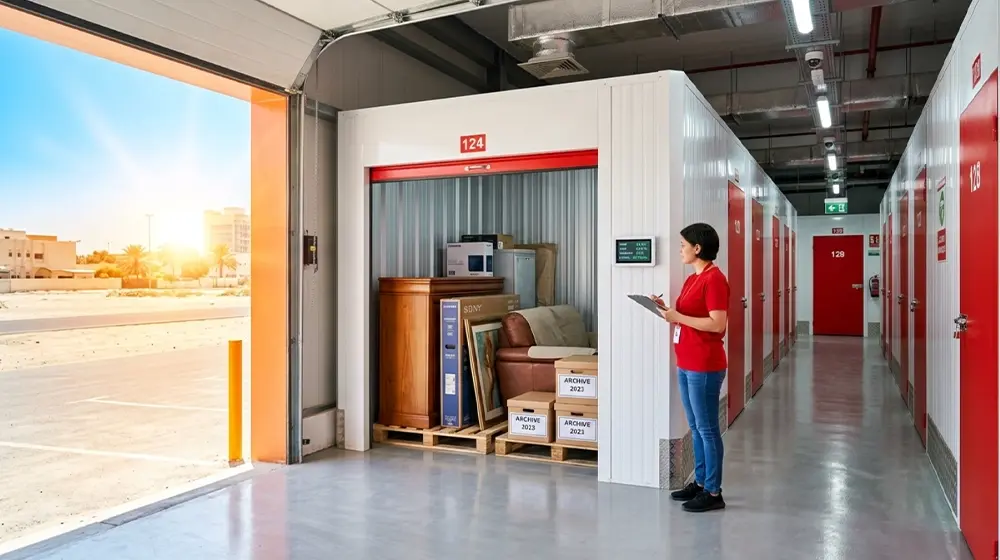
Climate-controlled storage matters in Sharjah because stable temperature and humidity reduce mold conditions, wood movement, odor retention, and finish stress. EPA guidance identifies below 60% relative humidity as the moisture-control threshold, with 30% to 50% described as the ideal range. CPSC gives the same 30% to 50% recommendation for homes, and CDC says indoor humidity stays safest no higher than 50% all day long. Climate controlled vs standard storage in Sharjah explains the same decision in practical terms: humidity exposure risk versus monthly storage spend.
Climate control protects 4 material outcomes:
- Reduce wood expansion and contraction
- Reduce mold probability
- Reduce odor buildup in fabric and foam
- Reduce stress on veneer, polish, and adhesives
How fast does moisture become a storage problem?
Moisture becomes a storage problem within 24 to 48 hours if a material stays wet or damp. EPA says mold usually does not grow when wet materials are dried within 24 to 48 hours after a leak or spill. The same timing matters for damp sofas, wet mattresses, recently cleaned furniture, and items wrapped before complete drying.
How should furniture be prepared before storage?
Prepare furniture in 6 steps: clean, dry, disassemble, label, wrap, and elevate. This sequence reduces dust adhesion, moisture retention, hardware loss, and surface abrasion. The U.S. Forest Service ties correct drying, handling, and storage to reduced moisture-content change in wood during transit and storage.
Follow this 6-step preparation sequence:
1. Clean surfaces
Remove dust, oil, crumbs, and stains from wood, metal, leather, and fabric.
2. Dry materials
Dry all surfaces completely. Moisture trapped in seams, foam, or wood joints increases mold risk within 24 to 48 hours.
3. Disassemble large items
Disassemble beds, tables, wardrobes, and shelving. Smaller components reduce handling pressure and corridor damage.
4. Label hardware
Label bolts, screws, brackets, and fittings by furniture item.
5. Wrap vulnerable surfaces
Wrap polished wood, glass, corners, and upholstery with suitable protective covers.
6. Elevate and space items
Keep items off direct floor contact where possible and avoid crushing light furniture under heavy furniture.
Which storage features reduce furniture damage?
Seven features reduce furniture damage: access control, CCTV, climate control, dry interiors, pest prevention, correct wrapping, and organized placement. CPSC adds that standing water, wet materials, and damp surfaces support molds, mildews, bacteria, and insects.
The 7 damage-control features are:
- Control entry
- Monitor units
- Stabilize air
- Maintain dryness
- Prevent pests
- Protect surfaces
- Organize placement
How do you choose the right storage type for furniture?
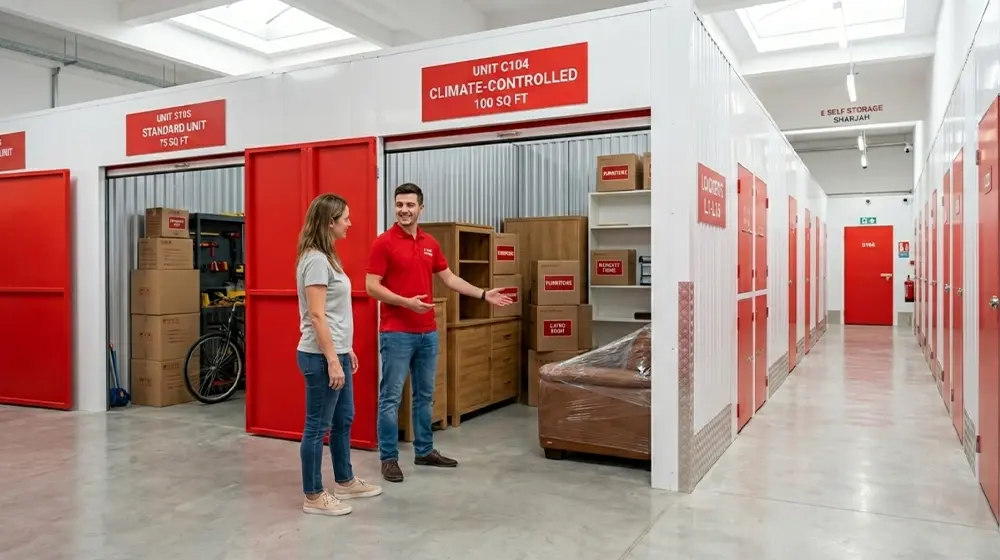
Choose storage type by matching 3 variables: material sensitivity, storage duration, and replacement value. Standard storage fits low-risk, short-duration items. Climate-controlled storage fits wood, leather, upholstery, mattresses, documents, and higher-value furniture, especially when storage duration exceeds one month. The live Sharjah comparison page frames this as a measurable cost-benefit decision for furniture with wood veneer, solid timber, leather, fabric upholstery, and boxed textiles.
Use this 3-part storage decision:
- Use standard storage for low-value, low-sensitivity, short-stay items
- Use climate-controlled storage for wood, leather, fabric, foam, and long-stay items
- Use unit sizing based on inventory count rather than guesswork
The Sharjah service page lists unit sizes from 20 SQFT up to 300 SQFT, which supports size selection by item volume rather than generic estimates.
What questions identify a good furniture storage provider?
Ask 6 questions: what are the storage conditions, what humidity controls exist, what security exists, what unit sizes exist, what handling support exists, and what access policy exists. These 6 questions map directly to the main furniture-storage risks: moisture, dust, pests, poor handling, under-sizing, and retrieval problems. Furniture storage during villa renovation in Sharjah uses the same controlled-workflow logic for packing, humidity protection, and safe return timing.
Ask these 6 provider questions:
- What humidity and temperature controls operate inside the unit?
- What materials qualify for climate-controlled storage?
- What CCTV and access controls operate on-site?
- What unit size matches my inventory list?
- What pickup, wrapping, or moving support exists?
- What access hours and retrieval rules apply?
What is the best way to keep the article informational and unbiased?
Keep the article informational by focusing on material behavior, storage conditions, preparation steps, and provider-selection criteria. The page stays useful when it explains how humidity affects furniture, how moisture creates mold risk, how wood responds to moisture-content change, and how storage features reduce damage. Official guidance from EPA, CDC, CPSC, and the U.S. Forest Service supports those operational points without turning the page into a sales page.
What is the final answer about furniture storage in Sharjah?
Furniture storage in Sharjah works best when the storage environment matches the furniture material, the storage duration, and the moisture risk. Climate management, fast drying, correct wrapping, clean interiors, and secure access reduce the main damage pathways for wood, leather, fabric, foam, and mixed-material furniture. EPA, CDC, CPSC, and the U.S. Forest Service all point to the same conclusion: control moisture, reduce humidity, and store sensitive furniture in stable conditions.
Frequently Asked Questions
Furniture storage in Sharjah is a secure short-term or long-term storage service for household and office furniture during moving, renovation, downsizing, travel, and space shortages.
Climate-controlled furniture storage matters because stable temperature and humidity reduce mold risk, odor retention, wood movement, and surface damage in sensitive furniture materials.
Damp furniture develops mold risk within 24 to 48 hours if moisture remains trapped in fabric, foam, wood joints, or wrapping materials.
Wood furniture, leather sofas, upholstered furniture, mattresses, veneer cabinets, and antique pieces need the most protection because moisture changes their materials faster.
Prepare furniture for long-term storage by cleaning, drying, disassembling, labeling, wrapping, and spacing each item according to material sensitivity and storage duration.
Check humidity control, security, pest prevention, unit size, handling support, and access policy before choosing a furniture storage provider.
Hayyan is a logistics veteran with over 15 years of experience in facility management and spatial optimization. He specializes in warehouse security, climate-controlled storage protocols, and the technical logistics of large-scale moving. His focus is on helping clients maximize their square footage while ensuring the long-term preservation of their inventory and belongings.
Thuraya is a specialist in home organization and residential transition management. With a background in interior space planning, she helps individuals navigate the complexities of downsizing and relocation. She provides expert advice on packing fragile items, choosing optimal storage unit sizes, and turning the stress of moving into a seamless, organized experience.